

028. FAULT LINES
exits & entrances

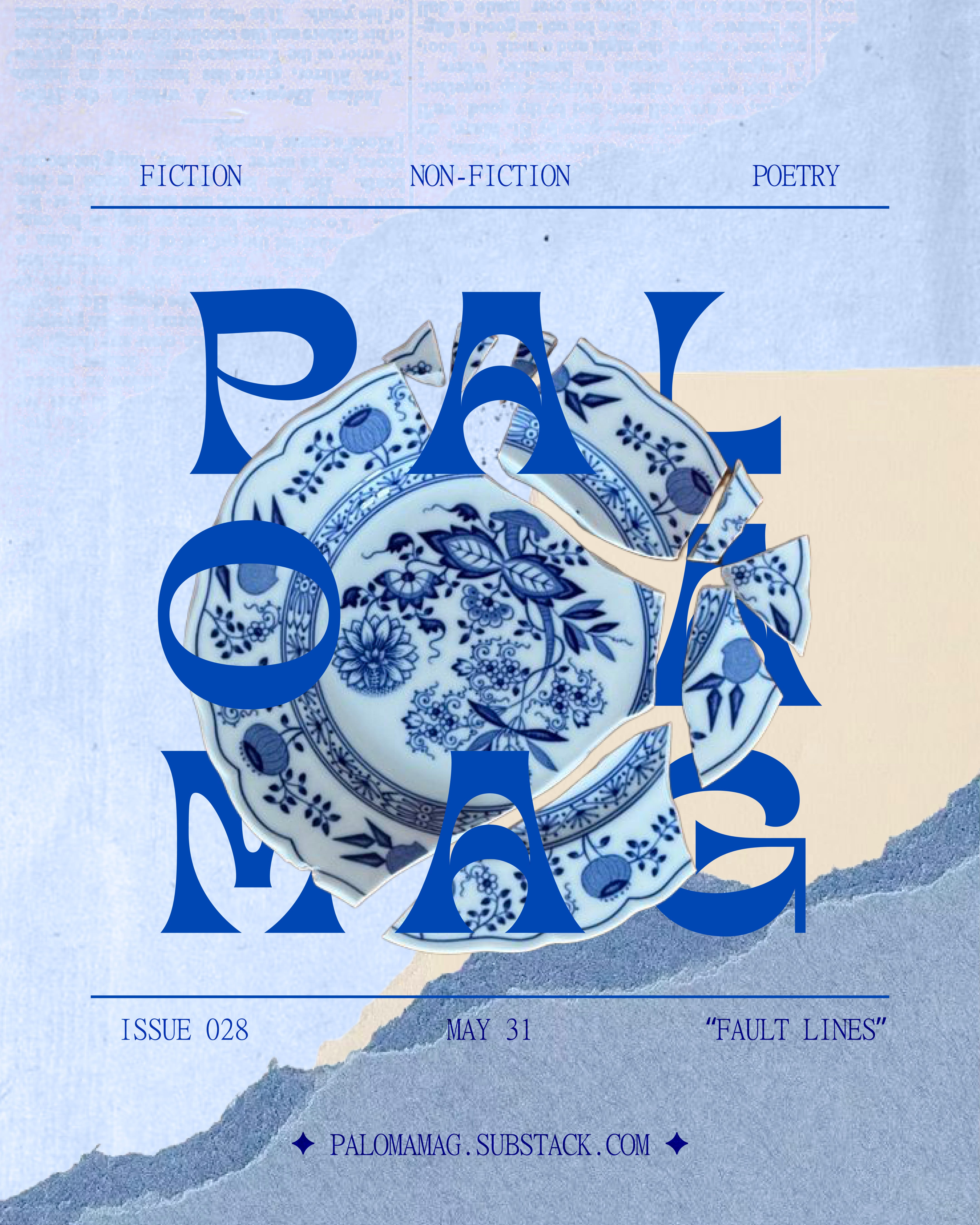

Welcome to Issue 028: Fault Lines
With a fault line as an opening in perception, the hidden becomes the known. An unreliable structure or voice can be guides worth distrusting. A splinter lodged under your skin connects you to the shape of its original whole. Whether a canyon or a marriage, only cracks can reveal depth. In this issue, division is extraction, expansion, extension. Memory is faulty and this is unstable ground we dance on. You can afford to separate yourself. You are “not physically lost / not yet” (Ash Point, Sarah Payne). So from the gap, make a path. Find the rocky masses’ interface, find “what connects / melt” (Breakup Week, Mic Jones). Let boundaries be the records of contact you’ll wish you’d kept. Wonder what exists there, when you let yourself “be injected with contrast” (Giving Every Imagination Flame, Sarah Payne). In Chopin’s Étude, Rhyni Thanya aptly collapses scales: “if she’d learn the ways of a structural engineer, she’d find pieces of my body under her bed.” In the process of break, the fault line reveals the ways vocabulary is shared. For example, pictures of sinkholes. All edge, all hunger’s inward collapse, a crater’s undisciplined magnetism. Jeans full of holes. Punctuation as break, curvature as fold. Anyway, the catastrophe you’re looking for is subterranean. It happens before you’re able to see its fragments. “See how this grabs you” (Bugbear, John Christopher Nelson). See how fluidly a sharp cut interrupts you. How unliteral the accurate translation, how undead the end. Geographies of contradiction emerge in the itchy seams of writing, between story-telling and truth-telling. Roads, veins, cables, ribbons want to be followed. “She was waiting for the spell, the spells she’s cast, to catch up to her” (She Called Me Today, Emily Spacek).
Enjoy paloma magazine’s issue 028 — let it inject you with contrast
Nilay Conraud | editor-in-chief

Bugbear by John Christopher Nelson [Non-Fiction]
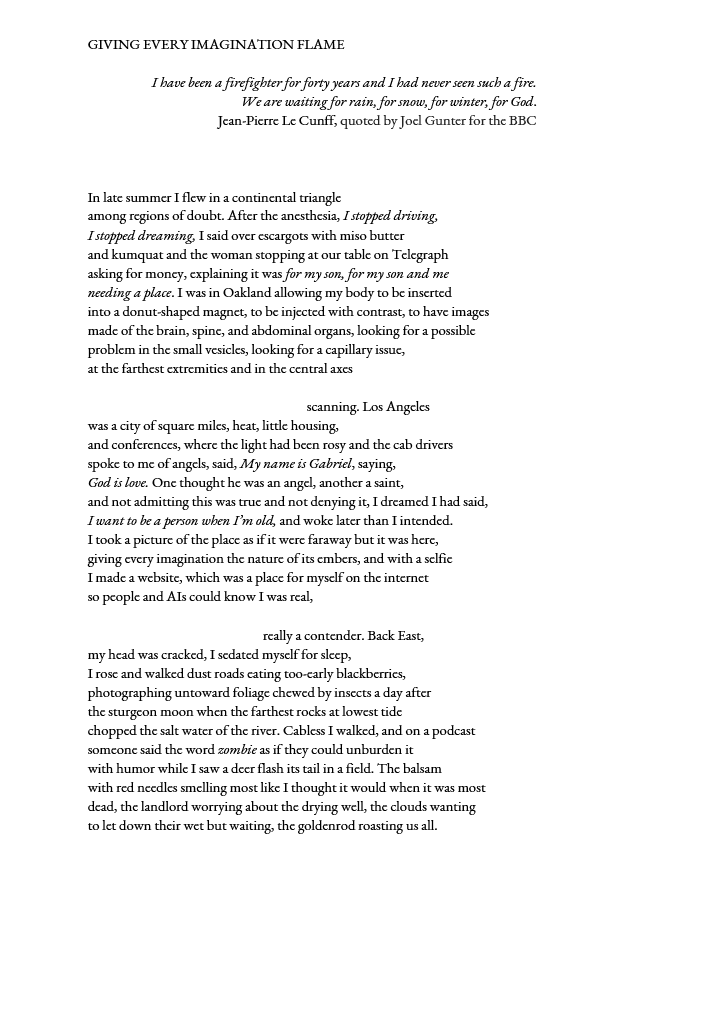
Giving Every Imagination Flame and Ash Point by Sarah Payne [Poetry]
She Called Me Today by Emily Spacek [Fiction]
Chopin’s Étude by Rhyni Thanya [Non-Fiction]
Breakup Week by Mic Jones [Poetry]
Bugbear by John Christopher Nelson | Instagram | Website
I’m trying to think of a word for the explicit dread that follows reconciling paranoia, when it hits me: I’m not allowed to be maudlin anymore. In terms of the antithesis to paranoia, reality, I guess? My literary lens de jure is naturalism, which explains why I’m prone to being fatalistic, but not why I’m so frequently accused of martyrdom. I’m guilty of both, I suppose, because it amused me to be told that I’m like Jesus, but in a bad way. What’s the point of pretending wellness if your well-being doesn’t register upon the insouciance of your adversaries? See how this grabs you: after Dad died of early-onset dementia, I inherited the break-barrel shotgun he purchased for, like, sixty bucks from Sears when Mom was pregnant with me in ‘84. They lived on an isolated piece of property and the sheriff had implied to my father that, should anyone aim to harm them way out there, they’d likely achieve their sinister designs by the time help arrived. Point being, half the reason I didn’t pull the trigger any of the times I’d given it a throat full of double-ought and cocked its hammer, is as brazenly simple as a Catholic childhood and the attendant fear of my deserved seat in hell, whether or not I believe in God. The goofy detail there is that I still pray to Him. Also goofy that my search history now evidences my confirmation that one need not, in fact, italicize the name of a department store. Like, I think I knew that from college, but better safe than sorry, or whatever. The other half a reason, though, is how can someone without friends imagine enemies and what’s the purpose of melodrama with no audience? Some proven solutions: 1. Despite innumerable parties regularly taking pains to exclude me, as many have actively conspired toward my ruin. Make up your minds, guys. I mean, whichever their preferred path, my personal history is riddled with cabals hellbent on ensuring that I know how unlikeable and universally loathed I am. No surprise to anyone then, that after barely slipping past death’s embrace twice during my month-long ICU stay (I almost pulled a Leaving Las Vegas, but in Reno), nobody cared. 2. And yet, and yet. Better still, when I failed to die, they cared somehow less, but simultaneously granted an implicit acknowledgment. Like, oh great, He’s still alive? Good grief. Self-centered thinking is intrinsic to addicts, and physical sobriety doesn’t relieve me of alcoholism’s many-charmed nature. Still, the purpose of my survival can’t possibly be to endure further smug susurrations of nominal friends. Mine is a disease of isolation, my inability to gain a sense of worth through human relationships is patently clear. It’s weird being forty, saying young people, and meaning it. It’s annoying and unromantic that I lived, truly. But young folks, lacking life experience, prefer to misunderstand and thus mythologize grotesques like Bukowski. But, once you’ve been consumed by substance use disorder and stuck around long enough to die, it’s not as romantic or edgy or whatever. And okay, sure, I’ll allow that these kids probably drink in problematic ways, but after twin diagnoses of alcoholic hepatitis and cirrhosis, I’m harder to impress. I humbly submit that I was a top-tier alcoholic, like, I was really good at it, but I forced myself into early retirement with a career-ending injury. Woops. Fan-favorite fact from my MVP card: one of the doctors assigned to me said I had the most enlarged liver she’d ever encountered inside a living person. But yeah, let me tell you, the dual failure of the hepatic & biliary systems is, like, deeply unsexy. It’s not glamorous or rad. And after that, you still have to look in the mirror. Sure, you’re easier on the eyes sober, but that doesn’t mute your ugly, gawking soul. Since my discharge date, I’ve just been rawdogging sobriety for the first time in two decades, unmedicated for assorted psychological problems because I’m uninsured, because I’m unemployed. And still, clandestine sadists get their jollies by provoking my anxiety, hiding behind therapy words & virtue signals while reminding me of my worthlessness. At least my schoolyard bullies were honest with themselves. Gosh, I do miss being maudlin, but I happily remain a total brat. You can count on my brattiness. Where most folks get it wrong is, it’s not a distortion of me that’s engendered by alcohol, it’s the authentic me that drinking discloses. Sobriety is the antidote. I am, thankfully, advantaged by the knowledge that the duration of my borrowed time is undecided. My liver could give up the ghost, without warning. All of this is just extra for me. So what do I care? The people I hate more than they think they hate me will continue to think me a farceur. Meanwhile, my resentment of them is as important as the threat of death, as far as maintaining my sobriety. Nothing a Taurus loves like digging in their heels to prove a point. None of it matters, though. I don’t matter, nor does anyone’s opinion of me. How little I matter is none of my business. I guess that’s the true definition of naturalism: not a single atom in the universe cares. And isn’t there, weirdly, some peace in that? Oh, right, also, the other fun thing about paranoia. Whether pilot or passenger, the alcoholic half is always creeping around my soul. If it’s not at the wheel, it’s happily directing traffic in my mind. Often as anything, my paranoia is just me, misleading myself. So, in terms of everything I’ve just related: it’s just as likely that I’m wrong.
Giving Every Imagination Flame by Sarah Payne | Instagram
Ash Point by Sarah Payne | Instagram
She Called Me Today by Emily Spacek | Instagram
One night we stayed in. We sat on the opposite ends of the tub in our swimsuits, comparing the most likely ways we’d die. She knew hers right then and there, without a doubt. A head-on collision, she said. Crushed by a semi truck on a two-lane highway out in the vast Great Basin. I asked questions, where and why. Visiting her ex in Reno, she said. She leaned over for the boxed wine balanced on the closed toilet lid beside us. Twenty over she’d be going. Somewhere between Fallon and Fernley.
“But that’s how Devin died,” I said.
Some of the purple red wine splashed up from her glass and into the bath as she settled back in. “You don’t think death can repeat itself?” she asked.
Sarah and I had a different set of cousins because we were only half-sisters. Devin was one of hers.
“Besides,” she said, “he was in Hawthorne.” I was sure it was Tonopah. One of the minor details her aunt shared on speaker phone the night of Devin’s death.
“You’re a better driver than he was,” I offered.
So we raised a glass to him, having agreed long ago we weren’t ever going to be sad about death because we never wanted to be too scared to live.
Devin had been about our age, and, of all the three families between the two of us, he’d come down to see us in Vegas more often than anyone else ever had. When he visited, we’d have a buffet at the casino. He was a loud, heavy-drinking guy. Easy to talk to if you weren’t trying to be serious. And as long as I’d known him, he had one eye closed, which is why he couldn’t have been a great driver. I guess it was a lazy eye he just never got checked out, over the years getting lazier and useless until he could see less and less from it. Until the lid permanently closed.
We sipped on Franzia while the tub water cooled around us. I pulled my legs up closer to me, hugged them into my chest, a little unsure about where she was going with the car crash thing.
“You’ll live forever,” I tried to convince her. “You’ll live past me,” I said.
“But I’m the reckless one.”
I rolled my eyes. Sarah just didn’t like taking responsibility for her actions.
“That’s why I’m here,” I said. “We keep each other safe.” We raised a toast. “But seriously, quit it,” I said, sticking my foot out to poke her shin with my big toe. “You’re a safe driver.” I really believed she was. Also, I didn’t drive.
When Sarah left for Reno, to visit her ex and our parents (if she had time), it was spring break. All around our dorm floor, the pink sorority girls in apartment 201 packed suitcases for Cancun. It wasn’t our plan to live in a college apartment after graduating, but we just stayed and then stayed. The girls were out on the balcony cackling over which stencil to use for spray painting their frat cooler. I stood by the kitchen bar waiting for Sarah to come out of her room. I knew she was leaving and I couldn’t convince her otherwise. I heard it in her voice talking to Pete, her ex, while shoving laundry from the dryer into a hamper. Pausing to grab a pair of jeans and the Harley Davidson tank top we always took turns wearing. They really were exes, she liked to assure me, but they still called to fight. They still drove six hours one way to fight. She came out again and stood in the doorway of her room, holding a pregnant-wide tote bag. She was crying, her hands shaking.
“Take the keychain with your Swiss Army knife,” I told her.
“I think I’ll take the long way,” she said.
“Stop for gas before you really need it.”
I didn’t hear from her the night she first left. I finished folding the laundry she left bundled to wrinkle there in the hamper. I let myself worry as much as what was reasonable. Until I called my dad.
“She took the long way?”
“Yeah,” I said.
“So? She must have gotten too tired and stopped for the night. Maybe her phone died.”
There was nothing either of us could have done. Like I said, I didn’t drive. Dad was stuck in his chair, recovering from a stroke. My step mom couldn’t leave his side. So we all just hoped she would show up on their stoop the next morning, which is where I told her she really should go. But I’d seen her in this state before. I’d seen her desperation convince her that a bad decision was a better kind of pain. At least, that’s all I could assume was happening to her. We were only half sisters after all so maybe there was a side I couldn’t see.
“There’s a Mobile station off 395 and Tioga Pass, right at the corner of a town called Lee Vining,” she said, finally giving me the whole story over the phone. It was late morning. I had coffee out on the balcony and my computer for work, and I tried not to sound annoyed when I asked her why she didn’t call the night before.
“It overlooks Mono Lake, this blue salt lake with a black sand island and white rock tufas that stop migratory birds for rest and house year-round osprey. And the deli in the Mobile mart,” she said. “They were serving these big bowls of hot chili and wet French dips with sides of the crispiest fries. There was music out on the lawn, and, if you can believe it, a flying trapeze rigged out front.”
“A flying trapeze? At a gas station?”
“The place was more than a stop for gas. I had to check it out.”
So she told me how it was. The trapeze, ready to take her flying over the edge of Mono Basin, above the dust devils and into her last stretch out north. Of course she ended up at a picnic table with a strange young man, picking out of his open food containers.
“He said he could show me how it’s done. His words not mine. I didn’t take him seriously at first but then he actually got onto the wooden platform at least twenty feet up. I couldn’t believe he was going to do it, so obviously I had to stay and see.”
“So? What happened?”
“He grabbed the bar from its holder and it lifted his shirt up. His stomach was hairier than I thought it’d be. And then he was flying. His legs swung backward, forward, his body stake straight then bent to an L. Back and forth, back and forth, and then he turned one wrist around on the bar, then the other, turned his whole body so he faced the platform again and stuck the landing!”
That night, Sarah went with the flying man back to his campsite. Her replay was detailed, like she was savoring it. Her green Volvo followed carefully behind his car for the three turns after exiting the parking lot, his truck’s rear lights, her beacons, fuzzy round halos from too much drink. I knew I couldn’t judge her for it. Think of the buzz she must have felt then. That bleeding out of edges. Imagine that in a fragile state.
“So, are you making it up to Reno today? Mom and Dad are expecting you,” I asked her.
“I kind of want to hang out with him today,” she said. “Just one more night to soak it all in.”
“Call them at least.”
“I will, I will.”
“And the ex?”
“I don’t even want to think about him,” she said, which was good.
But three days passed and she was still out there camping with two sets of clothes, no money of her own, and the company of a man we didn’t know.
“Picture this,” she said over the phone days later, all breathy. “We’re camped next to a creek with wildflowers all blooming. In the morning, a quail leaves eggs in our shoes outside the tent! Breakfast! Don’t worry, I’m careful about the mosquitos. I help him catch grasshoppers in the meadow for fly fishing, which makes the best bait.”
She called me every other day for two more weeks until the spring didn’t feel so early and new anymore. I sat on the couch. “I don’t know how we’re going to get her back,” I said on another call with my dad, picking a strand of her dark black dyed hair off of the velvety couch cushion beside me. “Yesterday she said she spent the morning in a hammock watching gulls fly over the lake. ‘Feathers falling from the sky into the parking lot of the Best Western they had been squatting behind.’ She said when they hit the ground, they turned to pure silver.”
“Yes, I’ve heard of that.”
“You have?”
It seemed too hard for her to leave. She kept saying that there was more left for her to discover—obsidian in the mountain craters. Warm trail snakes that cured illness with their bite, coyote sounds in the night, and the rush to look one in the eye, which, assuming the moon was full, counted for good luck. What could I say to bring her down without bringing her down, too far? When our friends asked me if she was coming back, I just pretended like it was a normal detour.
When I finally came up on a bus to meet her where she was, we met at the Mono Cone, that white and red hut off the main drag that served white and red frosties in dense sugar cones.
“This ice cream will change your life,” she told me.
We went to the visitor center and the history museum. We walked through a park with weather-beaten mining tools, abandoned metal equipment, and signs about the history of the basin’s people before white settlers and after. Neither geology nor human history interested her much and she stood in the background waiting for my summary of the education materials before us.
“The magic of this place is waning,” she said. “I can feel it. Places like this always get ruined over time. It’s sad.”
This gave me hope that maybe she would be ready to leave, then. I was there to bring her back, she had to know.
We camped that night, Sarah and the flying man and me. They seemed to be playing homesteaders in love. We camped on the lake shore, up in the bushes. During sunset, we finished our cold lunch meat sandwiches and skipped over the nesting flies at the water’s edge to wade out into the lake. The salty water was denser than the ocean itself, and we floated bellies up with no effort.
“Every soak in the lake adds a new year to your life,” the man said. “The stars are casting their spells now. Look at them, look. Nowhere else is the sky so clear that the stars can access us like this.” Maybe my mistake was not allowing myself to be convinced. Sarah always said I was the skeptic. She was the reckless one.
The next morning, I had a bus to catch.
“Come up to Reno with me. I’m working the rest of the week from Mom and Dad’s,” I said.
She was just putting a hammock up at the campsite. The trapeze man glared at me.
“We can stop back here on our way home afterwards,” I added.
I wasn’t sure what he thought about the whole thing. What he thought it was. I pulled her aside on a walk down to the creek to filter water.
“You don’t want to see Pete anymore?” I asked about her ex.
“Pete.” She squatted down on a river boulder and looked away. “Pete hasn’t tried to get ahold of me once.”
“So, let’s go confront him,” I tried. Nothing. “What about Dad? He’s not doing so well, you know.”
“Can’t you see I just need to be here now?” she snapped.
So she wouldn’t come with me, which was her thing— if she put her foot down it was down. I walked to the bus stop alone. What choice did I have but to get on that bus?
I met Pete, her ex, after arriving and settling in for a few hours with my parents. They weren’t as worried as I was because, stuck at home themselves and aging, they were still drawn to the romance of it all, her stories, her voice on the phone reading them out like a fairytale.
Pete lived near the university, near a pizza place, which made me feel like we were all the same kind of stuck. We sat at a picnic table out back and folded slices into our mouths between words. I told him what was going on. Then, I asked him to give me his take.
“What do you want to know?” he asked.
“How bad was it when you two were together?”
“It wasn’t bad at all,” he said, shaking his head. “No, it wasn’t bad at all.” He sipped his beer. “Not at first.”
“Tell me about the good times.”
“It’s the usual stuff.”
“I doubt what’s usual for a relationship with her is the same usual for most.”
“I suppose not.”
“What was she like when you first met?”
“A screwball.”
“No, really,” I asked.
“Sarah never wanted to be a part of any of this normal life stuff, you know. That’s not what makes her happy.”
“Well, she hasn’t seemed happy for a while, and I’ve been blaming it on you,” I said.
He poured himself another glass of beer from the pitcher.
He talked about plunging into Tahoe on the coldest days of the year. And walking miles through the forest with bird seed in their hands to feed the chickadees on the ridge.
“We always ended up back together,” he said.
“You really did,” I said. “Even when I warned her not to do it.”
We made our way to Cal Neva to play some slots. The smoky air, flat and dry but cold, enveloped us as we swung open those heavy glass doors. We stepped into blinking light and machine noise.
“I don’t trust her,” I said, finally, after we sat down to the Cherry Riches.
“You shouldn’t,” he said.
“I don’t trust her taste,” I clarified.
He kept silent and picked at the hole in his jeans near the knee with one hand.
“Look,” he said. “You can’t force your ways on her. She has to come to the realization for herself that she’s being conned. And from what you say, she’s in a real crater. So it might take a while.”
“She’s on Mars. Burning up. It’s not good,” I said.
“But she’s safe?”
“She’s living in a tent.”
He flagged down the waitress to order a whiskey, but I suddenly felt like I’d had enough. That night I made my bed on the couch at my parents’ place, questioning whether I had messed up. Whether she’d ever forgive me for such a betrayal. My phone rang.
She was in the car, driving, and trapeze man was there, too. “I think we’re ready to come home,” she said. She sounded frantic.
“What’s wrong?”
“The car. It’s not right.”
“What do you mean ‘not right’?”
They were up on the pass, and the windows were down, so I could hardly hear her. She said it was a new car, new to her at least. An old white sedan she’d bought two hours prior in town with her last two grand. She said they needed to blend in.
“Blend in?” I asked.
I asked again and again what was going on. All I could make out was that they were on the run.
“They’re behind us now, sis,” she said. Then, directed to trapeze man, “I knew that was a cop. I knew it. I’ve been looking in the rearview for the lights to show up behind us at any moment.”
“But you don’t see anyone?” I butted in.
“I know they’re coming.”
“What did you do?” I asked.
“Nothing,” the trapeze man piped up. “We haven’t done anything. She’s freaking out.”
“Okay, look, just pull over. If you’re being chased, it’s better to stop now. Explain yourselves. Be calm.”
“I can’t,” she said.
“Can’t what?”
“Stop.” She was shaking, I could tell. Or maybe it was the car, maybe it was falling apart. “Praise the mountains and the rain, we need a storm to come carry us. I can’t do it.” She was waiting for the spell, all the spells she’s cast, to catch up to her.
“You can do it,” I went on. “Everything is going to be alright. Just come home. We’ll sort it out, whatever it is.”
The sounds of the wind got louder, there was a rhythmic clanging, and then the call dropped.
When the phone rang hours later, it sounded shriller than ever. Why had I never changed the ringtone to something more peaceful? Why did every call have to feel like it could be the end of the world?
She told me the whole story, this time, in a way I could understand. How her car lifted off the ground. How it was white in the sky like one of the gulls. It was white in the sky, white like the crust left on our legs, and on our arms, and on our stomachs, residue from a saltwater more concentrated than the ocean when we swam together. We swam together.
Chopin’s Étude by Rhyni Thanya | Instagram
It’s a known fact that a girl is born with a finite number of eggs. This reduces day by day, month by month but at the end of a lifetime, none of them magically appear, she had always carried them. Does that mean then, that I had always been a part of my mother? Why does that sound like a tragic ultimatum?
A fickle argument between a mother and a daughter starts like the notes of ‘Winter Wind’ by Chopin, the tune starting slowly until it breaks into a range of fingers stomping on each key unbidden. Once when I was 14, I decided that my kid would one day grow up knowing Homer by heart for I wished my parents had made my child-self read ‘the iliad’. But in my dream, my future kid had slapped my face, stating willfully that she hated books - words of old ‘noobs’ - and instead wanted to learn law like her grandmother - like my mother. What a disappointment for I know that she’d later regret her dismissiveness towards literature. I had told her what the consequences of following her ambitious ‘passion’ would cost her till she finally stopped arguing back, till she started smiling and agreeing with me through red eyes. But that’s all right, she understood my good will advice in the end. The dream ended with me opening the door to see books of constitution opened up with our gazes locked. She slammed them shut, gritting her teeth. I had woken up with a sweat as the fan blew its flap of tak-tak-tak hard as it might.
But had I not spoken sense into her?
Had I not told her what repercussions she would face at the cost of ditching a stable career for a riskier one?
Had my mother not slapped every man who told her a woman can’t study criminal law, stood on the ground of oaths till seniors with reputations told her she would do great?
Had my mother not taken my pen away, made me spit out that hunger to become a writer and turned me into someone else instead?
They took the broken Versailles and painted it in golden rims. Now visitors walk over Antoniette’s rugs in awe, standing behind the red tape, camera turned to corners she teared up in. Shoes not crossing the line, with stretch marks on arteries, they look at the crimson walls and applaud like spectators. A mother looks at the daughter and sees herself in her bones and lungs until she forgets that the very thing that makes them different, are those exact same factors. My mother cannot remember what her hands traced at 5 and so my sister runs free on her toes. But see, the more I grew to be 14, 16, 19, the closer I walked towards my mother until we stood in front of each other, a single line of separation between us. And the older you grow, the less you see. She didn’t wear her glasses that day. I saw her as a grown woman, short coloured hair, someone who had her mishaps, but learned to grow through them like a wildflower on a windy day. She sees me as the girl she once was, excited for arising opportunities, a social reputation to help her esteem, an unbloomed blossom who would walk an oily path of wrongs, holding onto cut vines until the world decides to look at her better. My skin becomes a darker tan, her blood courses through mine, someone pulls back my bones, crushing them cr-aa-c-kk until my shoulders become hers. Hands put ropes around my muscles and tighten them around bone splinters to slim me out as her, fingers dragging my hair until it pulls loose from the scalp, blood gushing out till my hair dyes in the red she has.
The line blurs-
The walls close up-
And she embraces me in her arms-
it’s okay-it’s okay-it’s okay-
And it is okay, even if nails dig deep through my gut, even as my throat heaved to spew out a thousand words of poetry she never looked at-
there’s not a heaven more
than in the arms of the woman who always had you beneath her bones - inside her womb.
Strip off the Versailles and the perfect plaster falls off. Let the engineer squeeze the pieces and turn it to the next Louvre. Where did the line diverge? A mother forgets to pull back her skin from a daughter to see her heart bleed a different shade of scarlet, a palm that traces another path as the soothsayer says, eyes that tear up over something that she never had to savour through - until the bitter taste starts to become numb on the tongue. Did I grow and become a different woman from the circumstances - or did my taste buds learn to might as well get used to it? Was it because it was my mother’s hand that held open my mouth until she made me drink that sour milk a few times, that had turned the drink to a saccharine nectar? One can’t keep retching all her life.
Tears of malignancy, as my mother calls them, flowed everyday when we had our Chopin’s Étude. If she’d learn the ways of a structural engineer, she’d find pieces of my body under her bed - my maroon lipstick she’d never wear, moments someone would remark at my wonderful rearrangements of the ABC’s with towers of Brontë’s, and let that clear glass step in. It turns translucent with her breath until she wipes it and smiles at me. My daughter, what a wonderful woman you are becoming.
But the next moment a red tape eases itself in, the earth cracking between us on dry land we forgot to water for the past decade. She sees my lungs pulled tight again until her past mistakes become indentations over my skin with black marker. The line smudges to fade as she steps over it, grips my shoulders and -
oh mother, what are you saving me from? The things you lost are not the things I’m losing.
Breakup Week by Mic Jones | Website | Instagram
for Kelsey
It was breakup week.
Up North, real stillness.
You can see the current
& I could feel my whole body
right there—is that a swan or
iceberg? We asked literal questions.
Perspective, Kelsey said.
Our ground receding by the hour
now, swan white ground cracked
cracking into a materially time
sensitive puzzle because
its shapes, what connects
melt. Between rupture’s
sound, the rare kind
of silence I remember
words are loose silks
to be adjusted
like names
I decided
I had to have
one of those. You
smoked my cigarette
& I was there, too.
Our dictionary texture,
raw denim. Your field
of tiny
icebergs, absent sun,
March swans, all three
being domestic: sunset,
dinner, & a bath,
& snow white snow
punctuates the dunes,
emphatic dollops, the waves
jingle, misting one
horizon, lily pond
of ice, it has its sound
in which I bathe
a bath of quantum
listening, the fracture’s
John Cage, a silence,
four minutes of looking
at what you have
never seen before, the pleasure.
The sheer pleasure. The shear
ground’s seismic murmurs
apropos its highest note
mist ribbons the city
atop of it, fundamentally
more real outside my apartment.
More than thirty
years & two seasons
in this gaze: the process
of breaking up right
now’s ground, the city
backgrounds
our temporary landscape,
it sings
the edge
before it breaks…crisp
sounds touching,
like building a blanket
fort
in not just
literal ways. If I get
high enough
interrupted
is the concept
of geography,
or no, it’s materiality,
like I’m thinking I should walk
more often, from Montreal
to Melbourne like is this
the collage where time melts
spring on the other side
of a yard, in foam
you can record.
In the south of France
exists Baudelaire’s
last remaining vocal chord.
Here is gothic reds: Kate Bush
& dogwood winter trees split
the typical April
greys. Silent Spring
soundscape. My surface,
an infrastructure composed of tiredness,
smoking, strolling, thieving,
interrupting & the road I had
been thinking about you
went down (the desire
line toward Pauline Oliveros),
theorizing gaps & residues,
negations, waves, wages,
the apocalyptic rhythms
of our variously fucked present.
Her apostles are present tense
bells I met
in theory,
“You can drown in a puddle.”
We literally sit on a season
edge, or no; I squat,
you lay. You want
fabric cut into the melt’s
shape against today’s architecture
of orange willow tree haze. Let’s
talk about the idea of transformation.
I begin to enjoy the presence of danger.
Life in dead ends. Fault lines,
repetition, yeah, I’m eating
exits & entrances. One
is a sound
of ice breaking
in bells in commas in the rain
a fissure’s symphony
for one day only
there’s a river
beside our morning feet
negotiating the leap
clockwork crushed
ice under our feet. Listen:

Thank you for reading paloma, a monthly art and literature magazine. For information on submitting your work, please see the Submission Guide. You can find us on Instagram, and you can catch up on past issues here.
Subscribe today to receive the next issue directly to your inbox ↓