

✸ OPEN 01
introducing a new film column.

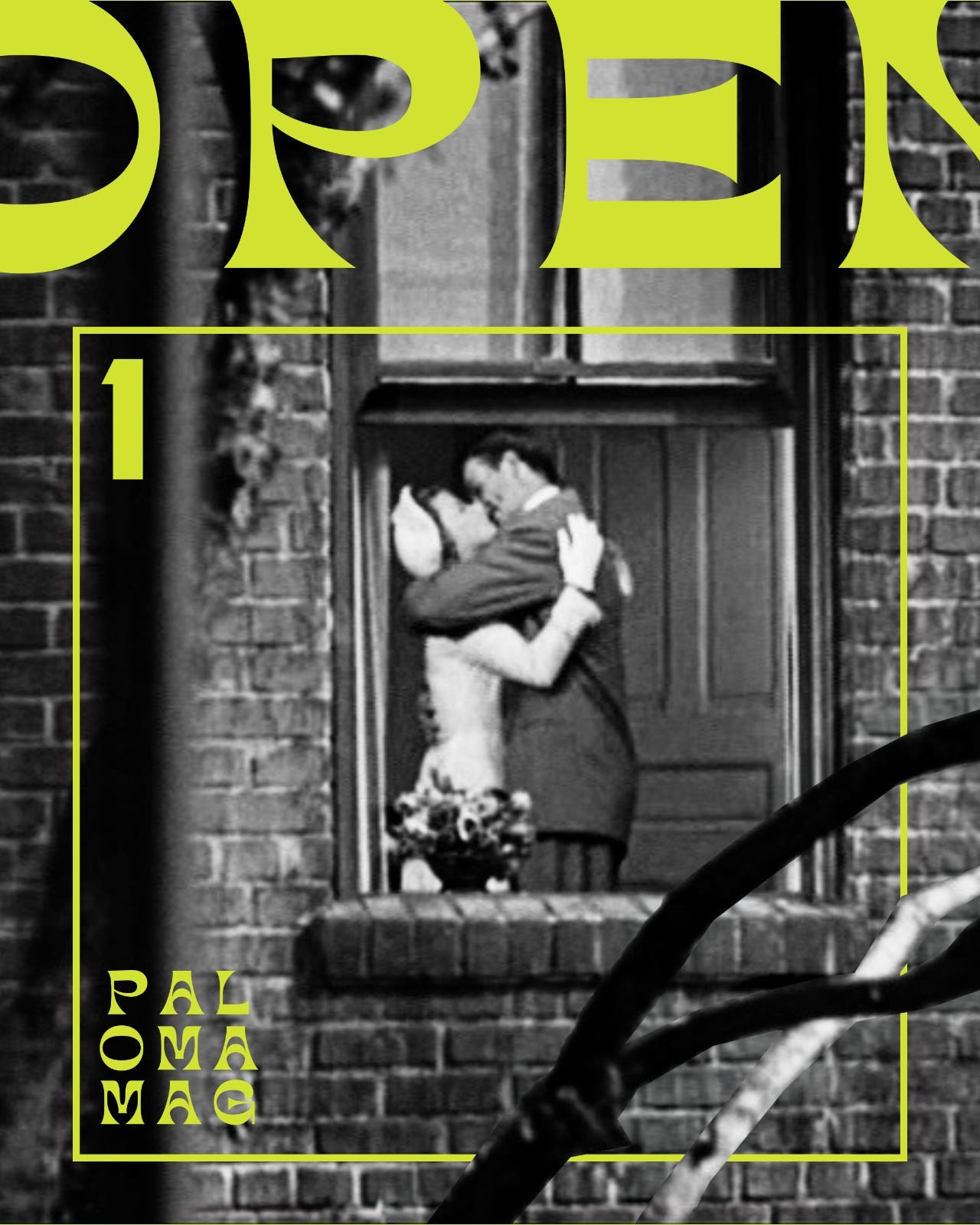
There are few movies I can replay in my mind’s eye with relative accuracy. Y Tu Mamá También. Anomalisa. A Woman Under the Influence. I think back to a beloved teacher, how he once told us that he cannot claim to have seen a film unless he’s seen it twice. I rarely watch films twice. I tend to forget details.
Days and settings I do not forget as easily. All the hubbub around a film. What I wore. Who I sat next to. Did I have a drink. The first and only time I watched Rear Window, the hem of my dress kept catching under my neighbor’s chaise lounge, and the sky around the inflatable projector screen was bare and blue. I had come to Arte Sommerkino at the invitation of a friend who would be leaving Berlin for the winter. I remember a distinct feeling of contentment. Smell of popcorn and warm tarmac.
Of the film itself I recall only fragments. My honest memory of the pivotal scene, when the journalist and the villain finally meet, goes something like this: door shadow bell laughter. In a more legible incarnation, it would perhaps read like this: the door swings open, a tall shadow looms in the twilight of the hall, the church bell rings, the church bell rings?
It was the clock of St. Matthew’s church across the street from the theater, sounding twelve times. Midnight. By the second slow, melancholy stroke, the whole plaza was already roaring with disbelieving laughter, joyous, full-toothed laughter, the kind that befitted a coincidence as perfectly perfect as the one we’d just witnessed: the film’s glorious suspense bursting out into the world in one big, thunderous scoop of sound. As if it could no longer be contained in its native format. All of this to say that I remember little of Hitchcock’s film, and yet perhaps I would have remembered even less had it not been for the unexpected interruption. The echoing bell a dowsing rod that can now divine my buried memories of Rear Window.
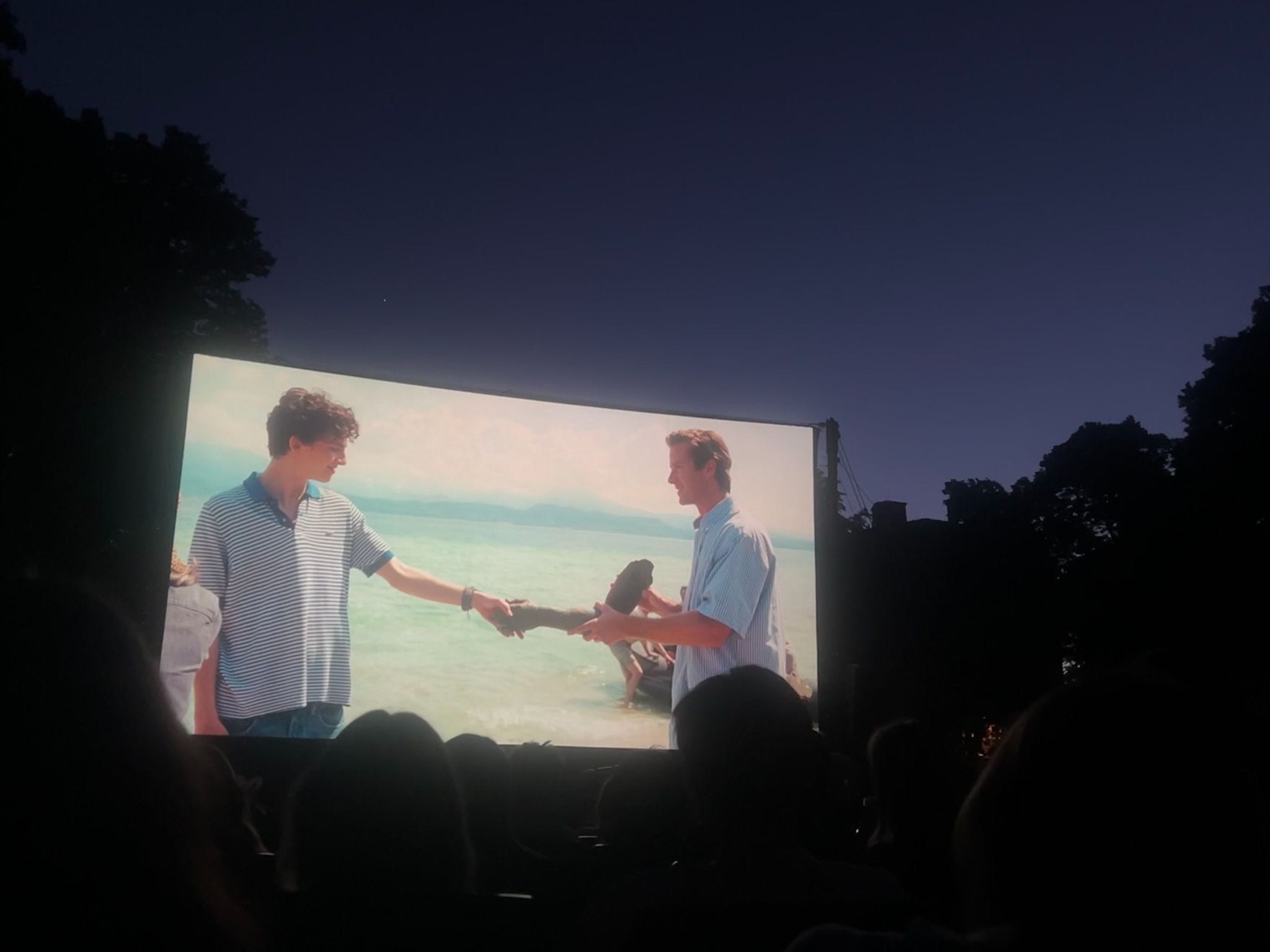
There is something quintessentially interruptive about outdoor screenings. You are exposed to the elements. The film, too, is exposed. All that you see and hear, taste, smell and touch seeps through the fabric of the film and comes to alter its texture from within. It is precisely this sensory receptiveness that makes the open-air experience so thrilling for me. Here is a space where cinema no longer transforms without letting itself be transformed in return. In the open air, a movie may unfurl into myriad iterations.
Some of these are more felicitous than others. In last year’s open-air edition of Berlinale, a screening of Gabriel Mascaro’s Silver Bear-winning The Blue Trail unwittingly became 4D, when the day’s dark clouds finally broke during the opening credits. It rained for the entire film, yet few people left the park. Those of us who stayed embraced the heavy downpour as an inside joke: our shared predicament couldn’t be farther from Mascaro’s tropical adventure, but in our drenched state we were also entering an immediate sensorial kinship with his protagonist, who’s partially or fully submerged in water for much of the film. A late scene shows her bathe on board a riverboat, her aged, suntanned skin made near-iridescent and new by the bucketful of water rippling over it. What to make of the rain pelting down on us in the park, then, if not embrace it as a most fortunate intervention, a singular enrichment of the aquatic drama onscreen?
Of course, open-air interruptions are rarely this sublime a complement to the cinematic experience. Most of the time they confuse or straight up impede it. I think of a late summer screening of Antonioni’s Blow Up, which got delayed by one full hour due to an undisclosed issue with the airscreen, so that afterwards my parents and I had to walk back home through dark and empty streets, lids heavy with the anticipation of sleep. Or of that one June evening in downtown Athens, when the honks and sirens from a nearby avenue turned a promising rooftop screening of Visconti’s Sandra into a scene as potently cacophonous as kindergarten recess.
Then there’s also the more personal grievances. The mosquitoes that single you out for the better part of two hours, the annoying seat neighbors. My memory of Bergman’s Autumn Sonata will always be shrouded in the thick cloud of cigarette smoke that the woman sitting next to me at the theater kept blowing in my direction. And to this day, no open-air interruption, good or bad, has been quite as bombastic as my own mother, who once drank a questionable mojito during a screening of Audrey Diwan’s L’Évenement, threw up on herself and her white plastic chair, and then fainted in a still-seated position. She was out for less than two minutes, but in the meantime, I’d already called an ambulance and escorted her out into the street with the help of the box office clerk. The screening went on without us, my mom is fine, and I’ve not yet watched the latter half of the film. Nor do I remember much from its first half.
And yet I couldn’t care less. Church bells, thunderstorms, street noise, mothers – it’s all part of the bargain. You might not seek it out exactly, but you sign up for it all the same, every time you watch a movie alfresco. In Greece, we have formalized open-air interruptions with the halfway break, a ten-minute interval intended for toilet runs, drink refills, and full body stretches. It doesn’t matter in the slightest whether the film is building towards a climax or slowing down; intervals always arrive at the exact midway point of any given screening. They certainly help the turnover, which is why Greek venues introduced them in the first place. But they’re also an invitation to attend to the world around us. To look up at the stars and down at our hands.
I’m partial to all kinds of interruptions: the good, the bad, the spontaneous, the planned. My fondest memories of moviegoing reach all the way back to the open-air theaters of my hometown. It was there that I watched the defining films of my adolescence. There, too, that I was first compelled to bestow upon a film the coveted honor of the best ever to be made. (Pan’s Labyrinth. I admit it had something to do with my name being in the title.) Open air became my cinematic norm, the bread and butter of my cinematic education. For the longest time, I’d conflate going to the movies with the absence of a roof, the heady aroma of summer nights, and this interruptive mode of watching that has followed me well into adulthood, and into every open-air screening I’ve ever attended. For even when all the drama falls away, when the bell stops sounding, the mosquito stops biting, the intermission ends and the skies clear, when nothing big or bold happens, in the exposure of open air some small portion of the world will always lurk behind the screen, singing. A film out in the open is never just a film.
Perhaps it’s a sin to relish in interruption. Cinema has always been conceived as an alternative spacetime, an elsewhere, a place in which to withdraw from the mental and physical confines of our reality. The controlled conditions of the movie theater codify the escape; open air spoils it. With its perceptual excess, it flings us back into the world. It reanimates the darkness, latches the floating heads back onto full-fledged bodies. At its most dangerous – at its most interruptive – it threatens the very ontological integrity of the medium, its whole raison d’être. It has us asking, time and again: how ought one to watch films?
Where we view something matters. No doubt about it. Yet outdoor screenings only distill what is true for all movies: their relationship to the world is always one of osmosis. The darkness of the theater also filters through the film, in ways that are more subtle than the sensory overload of open air perhaps, yet no less relevant. Everything, big or small, can penetrate the work. It’s this penetrability that makes it good. Open air lays the blueprint for a cinematic experience that is no longer conceived as an escape from the world, but as a return to it. To be sure, there is a significant degree of unpredictability to the format. Its varied interruptions may oftentimes turn distracting, or even disruptive. When they don’t, though, when they accidentally collaborate with the stories onscreen, they manage to attune them to something larger, to life itself.
I want this column to do something similar. To become a space where film and world may meet in much the same way that they meet in open air: at once subtly and energetically, in turns happily and violently. Unpredictably, too. Irreversibly, always. And so it is that I call the column OPEN. I envision for it a film criticism that will open onto various concerns and various voices, yours as well as mine. We might occasionally talk over each other, keen to join the hustle and bustle of a thought. But we’ll be all the better for this commotion.
I’ll follow up with more practical details soon. I can’t wait to read your contributions to our next issue. But for now, it’s the first day of summer. My dress is short, my hair’s pulled back. Once the sun sets, I’ll head to the park. I’ll watch a film under the stars.
Panagiota Stoltidou | film editor

Thank you for reading paloma. For information on submitting your work, please see the Submission Guide. You can find us on Instagram, and you can catch up on past issues here.
Subscribe today to receive the next issues directly to your inbox ↓
beautifully written, can’t wait for more 💌📽️
i love to see a fellow anomalisa enjoyer!!!! i also think some films are more suited to an open air screening than others. Case in point i went to see The Zone of Interest at the open air cinema last year with my boyfriend and because the immersive and eerie sound design is such a big part of the experience of watching Jonathan Glazer's masterpiece it didn't land as well with the audience as well as say Barbie or Mamma Mia (plus the subject matter being you know a genocide probably didn't help) I think musicals are the best genre of film to enjoy outdoors. Bonus points if you can sing along to the songs!